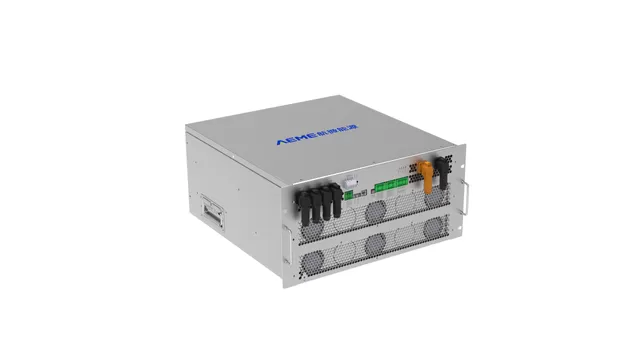
As renewable generation, distributed power and flexible electricity management become more important, battery storage is moving from a supporting technology to a core part of modern energy infrastructure. A battery energy storage system (BESS) is an integrated system that stores electrical energy in rechargeable batteries and releases it when required. For larger projects, a containerized battery energy storage system combines battery modules, BMS, PCS, thermal management and safety equipment in a coordinated enclosure, making deployment more modular and scalable.
A battery energy storage system is an integrated energy platform that stores electricity and controls when that electricity is charged, converted, monitored and discharged.
A standalone battery mainly provides energy storage. A BESS adds the systems required to operate that storage safely and intelligently. These typically include the battery system, battery management system (BMS), power conversion system (PCS), energy management system (EMS), thermal management and fire protection.
This distinction matters when evaluating an energy storage project. The required solution depends not only on how much energy must be stored, but also on power output, operating conditions, response requirements, safety and integration with solar, wind, industrial loads or the grid.
For buyers considering a containerized battery energy storage system, the container is therefore more than an enclosure. It can serve as an integrated platform for energy storage and associated electrical, thermal and safety equipment.

A BESS moves electricity through several coordinated stages rather than simply storing power inside a battery.
1. Energy generation: Electricity comes from sources such as the grid, solar PV or wind generation.
2. Power conversion: The PCS converts electrical power between AC and DC as required for charging or discharging.
3. Battery storage: Battery cells and modules store the electrical energy as chemical energy.
4. Energy discharge: When power is required, the battery releases energy through the PCS to supply a load, microgrid or grid connection.
A simplified energy path is:
Grid / Solar → PCS → Battery → PCS → Load / Grid
The BMS monitors battery conditions such as voltage, temperature and state of charge, while the EMS coordinates charging and discharging according to operating requirements.
For additional background on energy storage technologies and their role in power systems, buyers can consult the International Energy Agency (IEA) and U.S. Department of Energy.
The main components of a BESS work together to provide storage capacity, power conversion, monitoring and system protection.
| Component | What It Does | Why It Matters |
|---|---|---|
| Battery | Stores electrical energy | Determines energy capacity |
| BMS | Monitors battery cells and operating conditions | Supports protection and battery management |
| PCS | Converts AC/DC power | Controls energy flow |
| EMS | Coordinates system operation | Optimizes charging and discharging |
| Thermal Management | Controls operating temperature | Supports stable battery performance |
| Fire Protection | Detects and mitigates potential hazards | Adds an important layer of system safety |
This integrated architecture is especially important in large-scale projects because battery performance cannot be separated from temperature control, electrical conversion and protection systems.
AEME's current container BESS architecture, for example, combines battery storage with a three-level BMS, thermal management and automatic fire warning and suppression systems. Its listed container systems also support communication protocols including Modbus and IEC 61850.
A containerized battery energy storage system places major energy-storage components into a pre-engineered containerized structure, allowing larger systems to be transported, installed and expanded more efficiently.
The bess container approach is particularly useful when a project needs substantial energy capacity without constructing every subsystem separately on site. Factory integration can simplify wiring, system coordination and commissioning while providing a defined environment for thermal and safety management.
Typical advantages include:
Modular deployment for different project scales
Integrated battery, BMS and auxiliary systems
More efficient transportation and installation
Better use of project space
Easier system expansion
Centralized thermal and safety management
AEME's current MassPower container systems include 20-foot configurations with rated energy examples of approximately 5,016 kWh and 6,251 kWh. The listed systems use liquid cooling and can operate across specified temperature ranges, while the company also reports battery configurations supporting up to 6,000 charge-discharge cycles under stated conditions.
| BESS Configuration | Typical Scale | Main Advantage | Typical Use |
|---|---|---|---|
| Battery Cabinet | Small–Medium | Compact footprint | C&I |
| Container BESS | Medium–Large | Integrated architecture | Renewable / Grid |
| C&I BESS | Medium | Flexible installation | Commercial / Industrial |
| Microgrid BESS | Project-specific | Coordinated energy management | Microgrids |
AEME also offers C&I BESS configurations designed for commercial and industrial applications, including liquid-cooled and air-cooled systems.
A BESS can be configured for different energy-management requirements, so its value depends heavily on the application rather than storage capacity alone.
| Application | BESS Role | Main Value |
|---|---|---|
| Solar Energy | Store excess generation | Increase renewable utilization |
| Commercial Buildings | Peak shaving | Manage demand |
| Industrial Facilities | Load management | Improve energy flexibility |
| Microgrids | Energy balancing | Improve resilience |
| Grid Applications | Grid support | Improve flexibility |
For renewable projects, a BESS can store electricity when generation exceeds immediate demand and release it later. In commercial and industrial facilities, storage can support peak shaving, load shifting and backup strategies. In microgrids, the system can coordinate generation, storage and loads to improve energy management.
AEME currently describes its BESS solutions across C&I energy storage, renewable-energy generation and microgrid applications, with container systems also used in utility-scale and industrial projects.
For broader research on grid-scale storage and energy-system integration, NREL provides technical research and analysis on energy storage and renewable-energy systems.
Choosing a bess container manufacturer requires more than comparing battery capacity or a quoted system price. Buyers should evaluate whether the supplier can coordinate the battery, PCS, BMS, EMS, thermal system and safety architecture as one complete solution.
Key evaluation factors include:
Battery chemistry and capacity — Check the battery type, rated energy, usable capacity and expected operating conditions.
PCS architecture — Confirm whether the conversion system matches the required power, grid connection and operating mode.
Thermal management — Evaluate air or liquid cooling according to climate, system scale and operating requirements.
Fire and safety systems — Review detection, suppression, emergency shutdown and monitoring functions.
Communication and monitoring — Check whether the BESS can integrate with the project's EMS, SCADA or other control systems.
Environmental adaptability — Consider temperature, altitude, humidity, protection rating and installation conditions.
Testing and certifications — Request applicable test reports, certifications and technical documentation.
Project and service capability — Consider system integration, commissioning, technical support and long-term O&M.
For buyers evaluating a bess container manufacturer, an integrated supplier can simplify coordination between storage, conversion, thermal management and control systems. AEME states that it has more than 20 years of power-electronics experience and a 95,000 m² intelligent manufacturing center covering R&D, production, testing and assembly.
AEME's containerized battery energy storage system portfolio includes MassPower Containerized BESS and integrated energy-storage PCS and step-up container solutions. Its broader battery energy storage system portfolio also covers C&I BESS and power-conversion systems.
A BESS is not simply a large battery. It is an integrated energy platform in which battery storage, BMS, PCS, EMS, thermal management and safety systems work together to control how electricity is stored and delivered. For larger renewable, grid and industrial projects, a containerized battery energy storage system provides a modular architecture that can simplify deployment while supporting substantial energy capacity.
The right system should therefore be selected around the project's power requirements, energy capacity, operating environment, safety strategy and control architecture. AEME provides container BESS and C&I energy storage solutions for renewable, industrial, commercial and microgrid applications, allowing system configuration to be matched with different project requirements.
No. A BESS combines batteries with power conversion, monitoring, control, thermal management and safety systems.
A BESS stores electrical energy in rechargeable battery cells and modules.
A container allows batteries and supporting systems to be integrated into a modular structure that can be transported and deployed efficiently.
Yes. BESS can store surplus solar generation and release it when electricity is needed.
Capacity is mainly determined by the battery energy rating, typically expressed in kWh or MWh.
Ask about battery chemistry, capacity, PCS, cooling, safety systems, certifications, monitoring and after-sales support.


 +86-28-65790186
  info@aeme.global
 English