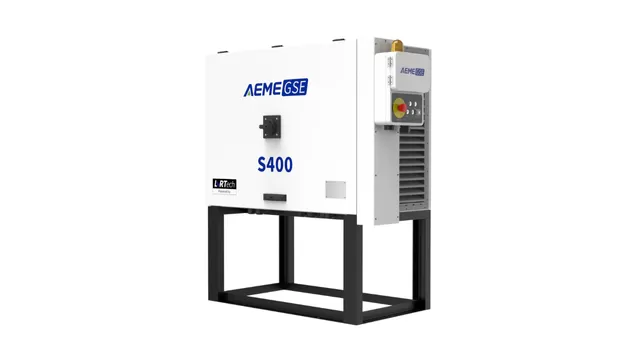
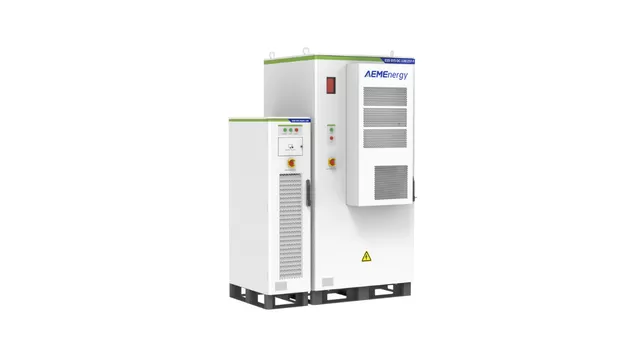
For decades, airports have relied on Auxiliary Power Units (APUs) - small gas turbine engines mounted in aircraft tails that burn jet fuel to provide electricity and air conditioning while parked. According to ICAO data, APUs account for 4-5% of total airport emissions, consuming over 1 billion gallons of diesel annually globally. The environmental cost is staggering: a single Boeing 737's APU emits 1.5 tons of CO2 during a typical 90-minute turnaround.

Our 90kVA Energy-storage Ground Power Unit: ECO TUG 90 eGPU changes this paradigm. By delivering 400Hz power, the system’s 91% operational efficiency far outperforms that of traditional APUs.
APUs were designed in the 1950s when environmental concerns took a backseat to operational needs. Today's regulators disagree - the FAA now fines airports exceeding emission limits, while EU ETS carbon pricing makes APUs financially punitive. The core issue lies in their thermodynamics: converting jet fuel to electricity through combustion wastes 65-72% energy as heat, per SAE Aerospace Standard AS6809. Maintenance costs compound the problem; Pratt & Whitney estimates $200/hour in servicing for PW900 series APUs.
During tests at Chengdu Shuangliu Airport, our ground power unit demonstrated <70dB noise levels while providing 115V/400Hz, 28VDC dual power output, ensuring reliable operation. Its automatic battery fire suppression system operates reliably, addressing concerns about electrical safety.
Aircraft Type | APU Fuel Consumption (kg/h) | APU CO₂ Emissions (kg/h) | APU Operating Cost (€/h) | GPU Power Consumption (kWh) | GPU CO₂ Emissions (kg/h) | GPU Operating Cost (CNY/h) |
C | 130 | 478.2 | 380 | 60 | 18.44 | 105 |
E | 408 | 1501 | 120 | 120 | 36.87 | 52 |
The above data is based on the operational conditions of a specific airline. Pricing varies across different airports and airlines, and parameter settings can be flexibly adjusted accordingly.
With the implementation of APU replacement and the shift from fuel to electric ground equipment, airport electricity demand has surged. This has led to challenges in energy saving and green airport development.
Leveraging airports' natural advantages for photovoltaic installation, we developed a high-efficiency, zero-emission green airport solution combining photovoltaic power, energy storage, and aircraft ground static power units to support the path toward "green zero-carbon" airports.
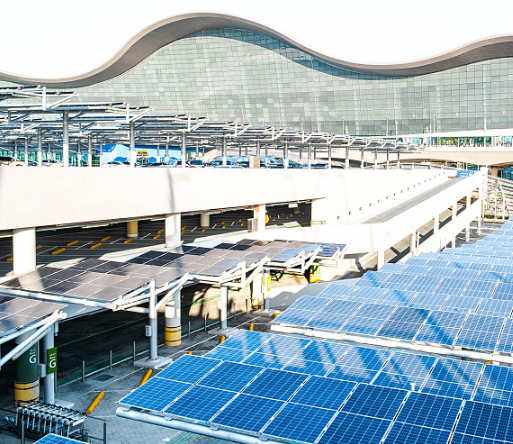
This solution uses an intelligent energy management system to coordinate power supply and control across all subsystems. It prioritizes photovoltaic energy consumption, draws power from the grid when needed. Surplus solar energy is stored in the battery system. The energy storage also ensures uninterrupted power during grid outages, enhancing the efficient use of renewable energy.
AEME's PV-Energy Storage Aircraft Ground Power Solution is in use at Chengdu Shuangliu Airport as a flagship case for civil aviation's energy-saving and fuel-to-electric initiatives and has been widely adopted in major hub airports.
Dr. Evelyn Koh is AEMEnergy's Chief Aviation Solutions Architect, with 15 years of experience developing ground support systems and multiple patents in high-frequency power conversion.
ICAO. (2023). Airport Carbon Accreditation Programme Manual, 4th Ed.
Boeing. (2022). Cascade Climate Impact Model, Table 17.
SAE International. (2021). AS6809A: Aerospace Ground Power Quality Requirements.
IATA. (2022). Ground Operations Manual, §12.3.4 Electrical Safety.
AEMEnergy. (2023). AGSP-ASS-090H-H Type Test Report, CNAS Lab Certification No. L7452.
 +86-28-65790186
  info@aeme.global
 English